Water conservation is rapidly becoming one of the UK’s most pressing infrastructure and environmental challenges. Drought conditions are becoming more frequent, reservoirs are under sustained pressure, and demand from households, agriculture, and industry continues to climb. Against that backdrop, artificial intelligence and smart technology are emerging as some of the most consequential tools available to those managing water at scale.
Smart metering delivers real-time visibility
One of the most immediate applications is smart water metering. Unlike traditional meters that rely on monthly or quarterly readings, smart meters transmit consumption data continuously, giving both utilities and customers detailed insight into how and when water is being used.

The impact is practical and immediate. Unusual patterns - such as overnight spikes or sustained increases - can be flagged automatically, allowing potential leaks to be identified before they result in significant waste or damage. With large scale smart meter programmes already underway across the UK, real time consumption data is becoming a foundational layer of modern water management.
AI driven Leak detection tackles a persistent problem
Leakage remains one of the most serious and costly structural challenges facing the UK’s water network. Ageing underground pipes lose billions of litres of treated water every year, and locating faults has traditionally been slow, disruptive, and expensive.
AI‑powered systems are changing that equation. By analysing pressure fluctuations, flow rates, and acoustic sensor data, machine learning models can predict where leaks are most likely to occur. Maintenance teams can then intervene earlier, reducing water loss, shortening repair cycles, and lowering operational costs. What was once reactive and labour‑intensive is becoming predictive and data‑led.
Predictive management improves network resilience
The same intelligence is now being applied beyond leak detection. AI is being applied to broader infrastructure health, monitoring the condition of pumps, treatment plants and pipe networks in near real-time. Instead of responding to failures after they occur, utilities can take a proactive approach, prioritising maintenance based on risk and asset condition.
This shift from reactive repairs to planned intervention not only improves reliability, but extends asset life and helps utilities make better long-term investment decisions. In an environment of rising regulatory scrutiny and climate pressure, resilience is becoming as important as capacity.
Smarter water usage in agricultural and industry sectors
Smarter water technologies are also delivering measurable benefits in agriculture and commercial environments. Precision irrigation systems, guided by soil-moisture sensors and weather forecasting models, are reducing water usage without compromising yields.
In commercial and industrial settings, from hotels and data centres to manufacturing sites, analytics platforms track and reduce consumption against defined targets, supporting both cost and sustainability objectives.
A structural shift, not a pilot programme
What stands out in the current phase of adoption is scale. AI driven water management is no longer confined to pilot programmes or experimental trials. It is increasingly embedded as standard practice across utilities, agriculture, and large commercial estates.
As water stress becomes a long term planning priority for the UK, the integration of intelligence into physical infrastructure is reshaping how water is managed, protected, and valued. The relationship between data, AI, and essential services is evolving - and in the case of water, that evolution is arriving not as a future ambition, but as an operational necessity.
Today’s news was brought to you by TD SYNNEX – the UK’s number one solutions distributor.
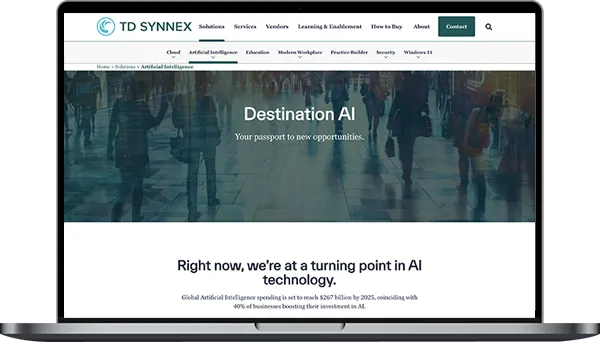
Destination AI
Destination AI from TD SYNNEX is our comprehensive end-to-end programme designed to help you and your customers get ahead of the AI curve.