Only 28% of AI use cases fully succeed and meet ROI expectations, while 20% fail outright, according to a recent survey from Gartner. Many initiatives stalled because businesses expected too much, too fast. When results are not delivered quickly, confidence ebbs and projects lose momentum.
► Many AI projects stall before delivering meaningful returns
► Integrating AI into existing workflows and securing executive support are critical to success
► AI initiatives are often over-ambitious or poorly scoped
The survey was conducted in November and December 2025, with responses from 782 leaders responsible for infrastructure and operations (I&O).

Gartner said that to ensure success, leaders should connect AI to the business during execution, not just planning. Among 77% of leaders who delivered at least one successful AI use case, success is attributed primarily to integrating AI into existing workflows and systems and securing full support from business executives.
Commenting on the findings. Melanie Freeze, director research at Gartner, said: ‘The 20% failure rate is largely driven by AI initiatives that are either overly ambitious or poorly scoped. AI that doesn’t fit into the organisation’s operations simply can’t deliver ROI.’
For the 57% of I&O leaders who reported at least one failure, many said expectations were unrealistic. They assumed AI would rapidly automate complex tasks, cut costs, or fix long standing operational issues without delay. When this did not materialise, the projects often collapsed.
Skills and data readiness also remain barriers:
- 38% cited persistent skills gaps
- 38% said poor-quality or limited data directly contributed to AI failure
According to Gartner, AI ROI is driven less by technology alone and more by how well initiatives are governed, integrated, and aligned to operational needs. It identified three key success factors:
- Embed AI into day-to-day systems: 33% of leaders with successful AI programmes integrated AI into tools employees already use, driving adoption and visible impact.
- Secure leadership buy-in: There is a strong correlation between success and buy-in from executives; removing roadblocks, aligning priorities and ensure the investment stays funded and focused.
- Start with realistic use cases: Most successes came from GenAI applied to IT service management and cloud operations, where markets are mature and business value is proven.
Freeze added that every AI use case should be linked to a business goal and teams should work alongside other parts of the organisation to set clear priorities. Senior leaders need to play a more active role in setting funding criteria and approving major investments to ensure strong execution and business adoption.
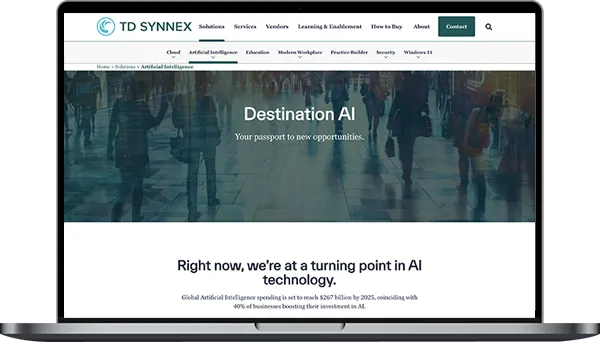
Partners can learn how to articulate AI use cases and value propositions through the TD SYNNEX Destination AI programme.
Destination AI
Destination AI from TD SYNNEX is our comprehensive end-to-end programme designed to help you and your customers get ahead of the AI curve.