Many customers see ESG (Environmental, Social and Governance) as a reporting requirement. The most successful sales teams see something more valuable: a way to uncover customer challenges that often lead to new business opportunities.
Sustainability initiatives frequently expose issues around ageing technology, budget constraints, asset visibility, and operational efficiency. Partners that recognise these signals early can position themselves as trusted advisors and engage customers on strategic business priorities rather than individual product purchases.
By approaching ESG through a commercial lens, sustainability conversations can become a starting point for stronger customer relationships, broader technology discussions, and new revenue opportunities.
Why ESG matters to sales teams

As organisations work towards sustainability goals, they are taking a closer look at how technology is purchased, managed, and retired.
For sales teams, these conversations can reveal challenges that might otherwise remain hidden, including:
- Unused technology holding recoverable value
- Delayed refresh programmes due to budget pressures
- Security concerns around retired devices
- Limited visibility of technology assets
- Sustainability targets that lack practical implementation
These issues are rarely standalone problems. They often point to broader opportunities where partners can help customers improve efficiency, reduce costs, or optimise technology investments.
What are circular IT services?
Circular IT services help organisations extend the value of technology assets beyond their initial deployment.
Services can include:
- Take-back programmes
- Asset recovery
- Remarketing
- Refurbishment
- Secure recycling
- IT asset disposal (ITAD)
Rather than treating devices as disposable, a circular approach focuses on recovering value, reducing waste, and supporting responsible end-of-life management.
For customers, that can support sustainability objectives while improving return on technology investments.
Five buying signals that reveal new opportunities
Customers rarely ask directly for circular IT services. More often, opportunities emerge through everyday business conversations.
1. A device refresh is being planned
When hardware is being replaced, customers need a strategy for the technology they are retiring.
This creates opportunities to discuss:
- Asset recovery
- Take-back programmes
- Secure disposal
- Funding refresh projects through recovered asset value
2. Technology budgets are under pressure
Budget challenges often prompt organisations to examine whether more value can be extracted from existing assets.
Potential opportunities include:
- Remarketing programmes
- Refurbished technology
- Cost-saving initiatives
- Asset value recovery
3. ESG reporting requirements are increasing
As sustainability reporting becomes more important, organisations often need greater visibility into how technology assets are managed and retired.
Potential opportunities include:
- Asset tracking
- Sustainability reporting support
- End-of-life planning
- Device management processes
4. The organisation has completed a merger, acquisition, or office move
Business change frequently creates surplus, duplicated or underutilised technology.
Potential opportunities include:
- Asset audits
- Recovery programmes
- Estate rationalisation
- Secure recycling
5. Security and compliance concerns are growing
Technology that reaches end of life can create risks if it is not managed appropriately.
Potential opportunities include:
- IT asset disposal services
- Secure data destruction
- Device retirement policies
- Compliance support
Recognising these signals can help sales teams identify opportunities earlier and have more valuable conversations with customers.
Three questions that uncover hidden customer needs
Many ESG discussions focus on targets and reporting requirements. A more effective approach is to understand how technology assets are creating, or losing, value across the organisation.
Consider asking:
What unused or retired technology is currently held across the organisation?
This can uncover dormant assets and potential value recovery opportunities.
How does the organisation measure the value of its technology assets?
The response can provide insight into refresh planning and asset utilisation.
What happens when technology reaches the end of its useful life?
This often reveals gaps in disposal processes, compliance requirements, or sustainability programmes.
These questions help move the conversation from sustainability objectives to practical business outcomes.
How sustainability conversations create a sales advantage
Many technology solutions are difficult to differentiate on price or specifications alone.
Conversations about technology lifecycle strategy allow partners to engage at a broader business level, focusing on outcomes rather than products.
This can help partners:
Differentiate more effectively
Customers increasingly value guidance that addresses operational and business challenges alongside technology requirements.
Increase account potential
Broader discussions often uncover needs across multiple projects and services.
Strengthen customer relationships
Earlier engagement around business priorities can create more strategic and longer-lasting partnerships.
The advantage is not sustainability itself. It is gaining a deeper understanding of customer priorities before they turn into formal purchasing decisions.
How TD SYNNEX supports partners
TD SYNNEX helps partners explore circular IT opportunities through services including take-back programmes, remarketing, recycling and TD SYNNEX Renew.
These solutions can help customers recover value from suitable assets, support sustainability objectives and take a more strategic approach to technology lifecycle management.
By connecting sustainability goals with practical technology outcomes, partners can create more meaningful customer conversations and identify new areas for growth.
From ESG conversation to revenue opportunity

The strongest sales opportunities often begin with a business challenge rather than a product requirement.
When customers discuss sustainability targets, budget pressures, asset visibility, or device retirement, they are often signalling wider organisational priorities.
Partners that recognise these signals can move beyond transactional discussions and position themselves as advisors who help customers make smarter technology decisions.
As ESG becomes a bigger consideration for organisations, the opportunity is not simply to talk about sustainability. It is to help customers reduce waste, recover value, and make technology investments work harder for the business.
Explore TD SYNNEX’s circular IT services and discover how sustainability conversations can help uncover customer needs, strengthen relationships, and create new commercial opportunities.
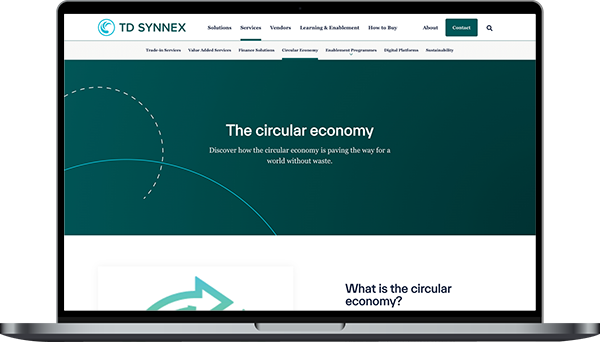
The Circular Economy
Discover how the circular economy is paving the way for a world without waste.