The debate over whether the AI investment surge is running out of control continues to divide the industry - and it matters. For partners, the risk is clear: if an “AI bubble” forms and bursts, it could not only impact investor confidence, but also the business confidence needed to sustain growth.
► Annual investment of $5 trillion will be needed between now and 2040
► Whatever the short-term outlook, AI is still expected to drive long-term productivity gains
Some industry observers remain dismissive of the risks and the idea that too much money is being pumped into AI. In July 2026, SoftBank Group CEO Masayoshi Son described talk of an AI bubble as ‘absurd’, stating that sustained investment is essential to unlock future value. He estimates that up to $5 trillion a year will be needed through to 2040 - and that if AI eventually accounts for 20% of global GDP, that level of spending will look insignificant in hindsight. As he put it: ‘If AI revenue makes up 20% of global GDP, spending 800 trillion yen [$5 trillion] a year is a rounding error’.

SoftBank’s own strategy, including major investments in OpenAI and data centre infrastructure, supports that view. But there are reasons for caution. In May 2026, OpenAI reported missing targets for both new users and revenue, while questions remain over whether the industry can sustain rapid infrastructure expansion. Around 1,500 additional data centres are expected to be built in the US over the next few years, on top of the roughly 3,000 already in operation.
Competition among major technology firms is intense, but it remains unclear how quickly that investment will translate into tangible returns. According to The Observer columnist John Naughton, companies including Alphabet, Amazon, Apple, Meta, Microsoft, NVIDIA and Tesla account for around a third of the US stock market’s valuation. Any shift in sentiment would therefore have wide-reaching implications across the industry.
Even so, history suggests that heavy investment - however excessive it may seem at the time - can still lead to lasting change. The railway boom of the late 19th century and the dot-com crash in 2000 both caused disruption but ultimately delivered significant productivity gains and reshaped markets.
AI may follow a similar path. Even if investment outpaces short-term returns, the underlying technology is likely to create long-term business value. For partners, the priority is not predicting whether a bubble will form, but ensuring they are positioned to capture the opportunities AI will create regardless.
Inspired by...
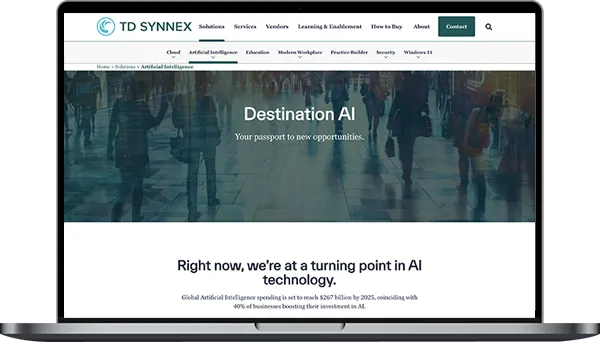
Destination AI
Destination AI from TD SYNNEX is our comprehensive end-to-end programme designed to help you and your customers get ahead of the AI curve.