Artificial intelligence is evolving beyond answering questions and generating content. The next phase is agentic AI, which enables AI systems to automate tasks and support business processes with limited user involvement.
As organisations look for new ways to improve efficiency, customer experience and productivity, understanding agentic AI is becoming increasingly important.
What is agentic AI?

Agentic AI refers to semi-autonomous or fully autonomous AI systems that can reason, plan and take multiple actions to achieve a specific goal. These systems, often called AI agents, interact with applications, data sources and business systems to complete tasks and deliver outcomes.
Unlike traditional AI tools, agentic AI can determine the most appropriate next action based on the objective it has been given.
What is the difference between generative AI and agentic AI?
Generative AI (GenAI) responds to prompts by creating content, answering questions or providing recommendations. The user decides what happens next.
Agentic AI goes further by connecting with other systems and carrying out actions automatically. Rather than simply providing information, it can help complete an entire business process.
How is agentic AI used in practice?
Customer service is one of the most common examples.
A GenAI-powered chatbot can answer customer enquiries and provide information. An agentic AI system can also authorise a refund, arrange a replacement part, update records and initiate follow-up actions.
Organisations are also using AI agents to automate approvals, support decision-making, identify potential fraud and streamline routine operations
Why is agentic AI challenging to implement?
While the potential benefits are significant, implementing agentic AI requires careful planning.
Organisations may need to redesign business processes, prepare data for AI use, integrate multiple systems and thoroughly test outcomes before deployment.
As a result, many projects involve collaboration between technology providers, partners and business stakeholders.
What are the risks of agentic AI?
Because agentic AI systems can act independently, clear controls are essential.
Without appropriate safeguards, AI agents could make incorrect decisions, access sensitive information or perform actions outside their intended scope. Regular monitoring and well-defined boundaries help ensure systems remain secure, compliant and aligned with business objectives.
What should partners do next?
Agentic AI has the potential to transform customer service, business operations and workplace productivity. However, success depends on selecting the right use cases and establishing a framework for responsible adoption.
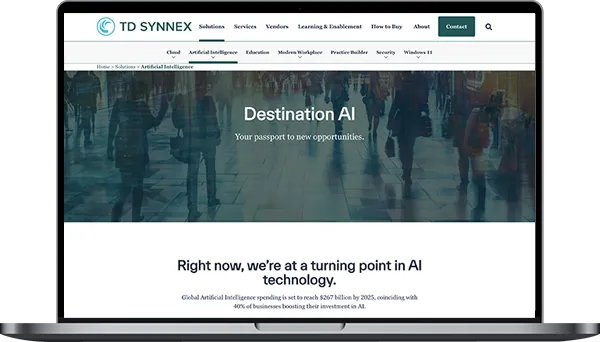
Through Destination AI, TD SYNNEX can help partners understand agentic AI, identify practical opportunities for customers and take the next step in their AI journey.
Inspired by...
Destination AI
Destination AI from TD SYNNEX is our comprehensive end-to-end programme designed to help you and your customers get ahead of the AI curve.